
It’s almost time to start using your retirement funds but figuring out how to draw from your retirement account isn’t always as straightforward as you might expect, especially if you have multiple sources of income.
At the end of the day, most retirees want two key things:
- Enough income each month to live comfortably.
- The ability to have their money last throughout retirement.
Thankfully, there are several thoughtful approaches that can help you accomplish both.
Before you solidify your withdrawal strategy, there are a couple key decisions to make, including —
- The amount of money you will need to withdraw each month to cover your typical expenses.
- How you should invest your money to achieve some growth while preserving your existing balance.
These decisions become more complicated if you have additional retirement accounts, such as other IRAs or 401(k)s, alongside your Eder Retirement Plan balance. And once you reach a certain age (currently 73), you will need to take money out via Required Minimum Distributions (RMDs), which ensure that your tax-deferred retirement savings eventually get taxed.
Start with Social Security
As you think about how to best use your retirement account balances, it's wise to make sure you receive the maximum Social Security benefit available to you. Once you establish what your Social Security benefit will be, you can then assess how best to take your retirement funds.
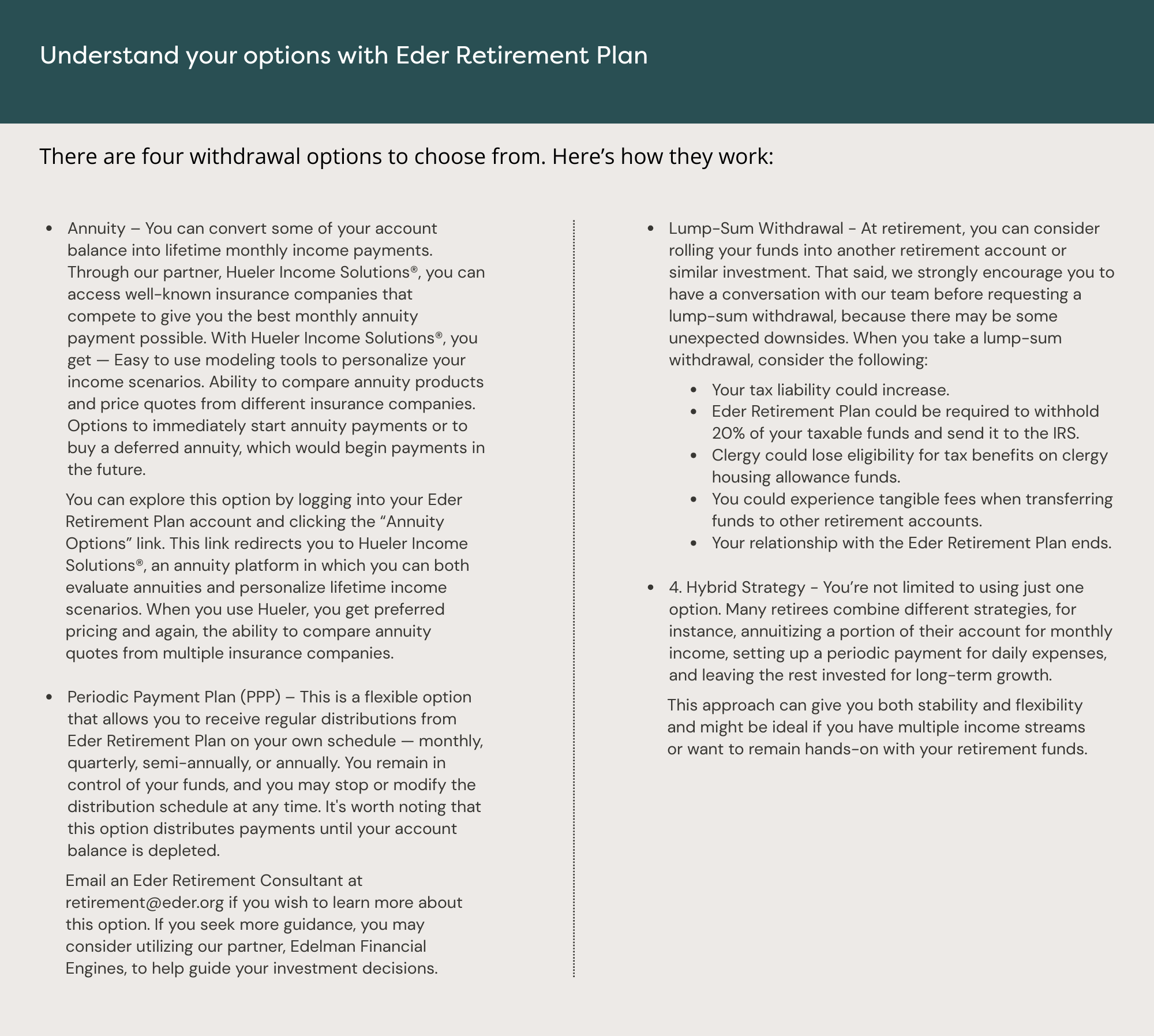
Understand your options with Eder Retirement Plan
With Eder Retirement Plan, there are four withdrawal options to choose from. Here’s how they work:
1. Annuity – You can convert some of your account balance into lifetime monthly income payments. Through our partner, Hueler Income Solutions®, you can access well-known insurance companies that compete to give you the best monthly annuity payment possible. With Hueler Income Solutions®, you get —
- Easy to use modeling tools to personalize your income scenarios.
- Ability to compare annuity products and price quotes from different insurance companies.
- Options to immediately start annuity payments or to buy a deferred annuity, which would begin payments in the future.
You can explore this option by logging into your Eder Retirement Plan account and clicking the “Annuity Options” link. This link redirects you to Hueler Income Solutions®, an annuity platform in which you can both evaluate annuities and personalize lifetime income scenarios. When you use Hueler, you get preferred pricing and again, the ability to compare annuity quotes from multiple insurance companies.
2. Periodic Payment Plan (PPP) – This is a flexible option that allows you to receive regular distributions from Eder Retirement Plan on your own schedule — monthly, quarterly, semi-annually, or annually. You remain in control of your funds, and you may stop or modify the distribution schedule at any time. It's worth noting that this option distributes payments until your account balance is depleted.
Email an Eder Retirement Consultant at retirement@eder.org if you wish to learn more about this option. If you seek more guidance, you may consider utilizing our partner, Edelman Financial Engines, to help guide your investment decisions.
3. Lump-Sum Withdrawal - At retirement, you can consider rolling your funds into another retirement account or similar investment. That said, we strongly encourage you to have a conversation with our team before requesting a lump-sum withdrawal, because there may be some unexpected downsides. When you take a lump-sum withdrawal, consider the following:
- Your tax liability could increase.
- Eder Retirement Plan could be required to withhold 20% of your taxable funds and send it to the IRS.
- Clergy could lose eligibility for tax benefits on clergy housing allowance funds.
- You could experience tangible fees when transferring funds to other retirement accounts.
- Your relationship with the Eder Retirement Plan ends.
In any case, having a conversation with an Eder Retirement consultant may help you discover a better strategy. To schedule a meeting, email retirement@eder.org
4. Hybrid Strategy
You’re not limited to using just one option. Many retirees combine different strategies, for instance, annuitizing a portion of their account for monthly income, setting up a periodic payment for daily expenses, and leaving the rest invested for long-term growth.
This approach can give you both stability and flexibility and might be ideal if you have multiple income streams or want to remain hands-on with your retirement funds.
Crafting your personalized withdrawal strategy
If you have multiple income streams or simply want more control over how and when you use your savings, it may be helpful to build a custom withdrawal strategy that reflects your unique goals and financial picture.
The transition from a regular paycheck to managing your own income can feel like a big adjustment. After a lifetime of predictable deposits every few weeks, budgeting for both everyday expenses and big-picture plans in retirement takes a new kind of thinking. That’s why having a thoughtful withdrawal strategy in place is so important. The right approach can:
- Help your savings last.
- Align with your investment and tax strategy.
- Offer peace of mind that your financial needs are covered.
Let’s explore a few additional strategies that may help you shape a plan that’s right for you:
- The 4% Rule
This popular method suggests withdrawing 4% of your total retirement savings in the first year and adjusting that amount each year based on inflation.
Example: If you have $500,000 saved, you’d withdraw $20,000 the first year. If inflation is 2%, you’d increase your withdrawal to $20,400 the next year.
It’s a simple, long-term strategy designed to help your savings last 30 years, though it assumes a steady spending pattern and a 50/50 mix of stocks and bonds.
- Fixed-Dollar Withdrawal
Instead of a percentage, you pick a dollar amount to withdraw annually for a set number of years.
For example, if you withdraw $25,000 each year for five years, you’ll reevaluate after that period and potentially reset your withdrawal amount to a more appropriate level going forward.
- Bucket Strategy
The 3-bucket approach is a withdrawal strategy that seeks to balance income, safety, and growth — depending on the time horizon of when you'll actually need the money:
- Short-term for income (0–3 years): Safe, liquid investments such as your retirement account (Ex. 401(k), 403(b) or IRA) pension, and social security.
- Mid-term for safety (4–10 years): Moderate-growth investments such as having cash-on-hand for emergencies, bonds, and CDs.
- Long-term for growth (10+ years): Higher-risk, higher-return assets like stocks and equities to grow your money and compensate for inflation.
To tailor this strategy to your unique circumstances and objectives, consult with a financial advisor.
- Earnings-Only Withdrawal
You withdraw only the interest and dividends generated by your investments, leaving your principal intact. This can preserve your savings, but the income may fluctuate, which can make budgeting tricky.
- Proportional withdrawals
With this approach, withdrawals are made from taxable, tax-deferred, and Roth accounts in a coordinated way to help reduce tax burdens. This strategy typically requires the guidance of a tax or financial advisor.
- Dynamic withdrawal strategy or “guardrails”
This flexible method allows you to increase or decrease your withdrawal amount depending on market performance. You start with a withdrawal rate, say between 4 and 6 percent, and set upper and lower guardrails. If your portfolio performs well, you may increase your withdrawals. If markets dip, you reduce your withdrawals to preserve your funds. This strategy helps you adapt to changing market conditions, and inflation, while staying on track.
Confidence comes with a plan
There are dozens of withdrawal strategies out there, but the best one for you depends on your income needs, your timeline, and how hands-on you want to be. The most important thing is to have a plan and don't feel like you need to go it alone. Seeking input from a trusted financial adviser can help give you perspective and ultimately assist you to make informed decisions that both protect your savings and support your long-term financial goals.
Eder Financial offers complimentary retirement planning consultations to members. To schedule a consultation, email retirement@eder.org. If you want to speak with a licensed financial advisor to get investment advice for the funds in your portfolio, Edelman Financial Engines, an Eder partner organization, can help. Call 833-400-1070. EFE financial advisors can answer questions about your specific retirement investment strategy.

.png?246x139)